
If items are the building blocks of assessment—and they are—then alignment to the domain model and alignment references are the chemical bonds that hold each block together. They are the difference between a bunch of stuff and crafting that stuff into something that can bear appropriate weight, fitting in with the other blocks for whatever purpose the test is put to.
Item alignment is incredibly important. Vitally incredibly important. So, putting aside fairness and bias (though, in fact, items with fairness issues are not aligned for everyone, so it’s an inhumane thing to do) and focusing for now just on the K-12 large scale assessment context, let’s quickly go through why alignment is important.
Understanding alignment starts with understanding the role of learning standards.
Our democratic processes empower particular people to make decisions about our schools. This begins with state legislators and governors, who may have ratified some set of state learning standards—thus giving them the authority of laws. In other states, it is a state school board that ratifies them, or perhaps senior officials in a state’s department of education, giving them the authority of regulations. Either way, they are ratified democratically, and thus they have the moral and legal authority of laws and/or regulations.
Because most state constitutions say that public schools exist so that our democracy can function with an informed voting citizenry, state learning standards can be understood as the state’s view of what would make for an informed citizen, or for someone who has the tools they need to become or stay informed.
Yeah, legal authority over education is in the hands of states. The federal constitution does not mention education, but state constitutions do. Legally, they are the authority, with power to dictate to districts, schools and their personnel.
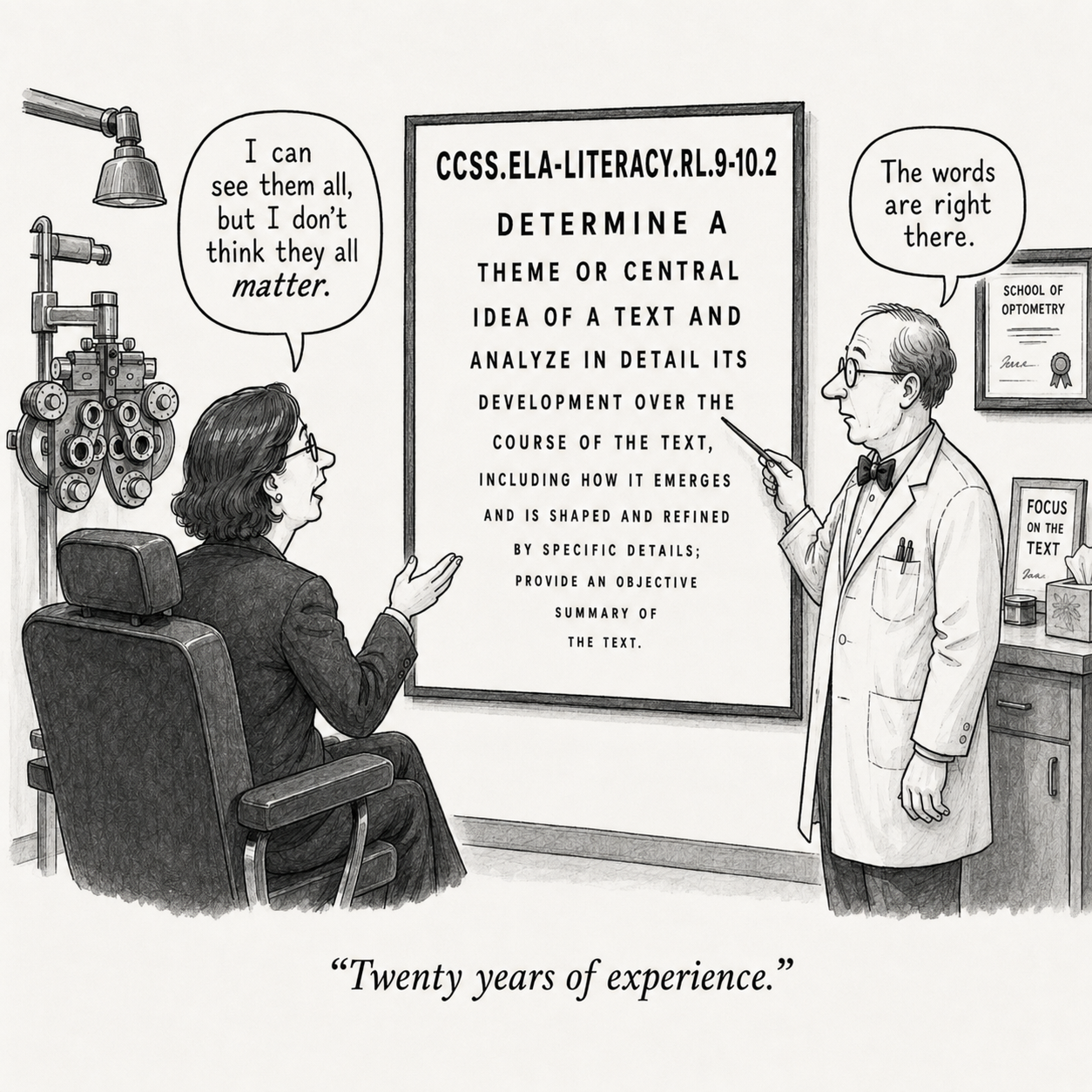
Like all laws and regulations, they necessarily exist in a particular written form. They communicate expectations. Though there may be some room for reasonable interpretation, they exist in a literal form and not just as spirit, ethic or vibe. Like any complex law or set of regulations, each set of standards must be interpreted as a whole and on the more precise level of individual requirements—always firmly grounded in what the law/regulation actually says.
Standards tell school districts and teachers what is expected of them and their students. They express the democratically determined expectations of the state for its schools in a form that every educator, every administrator and every member of the public can see. Surely, it is representative democracy rather than direct democracy—but it is democracy nonetheless.
Standards take power away from arbitrary and opaque whims of publishers and individual teachers. They are public, published and were subject to debate before ratification. The entire populace can see them, gain understanding of them, and even influence their form and contents. They can be altered through the same democratic processes that ratified them in the first place.
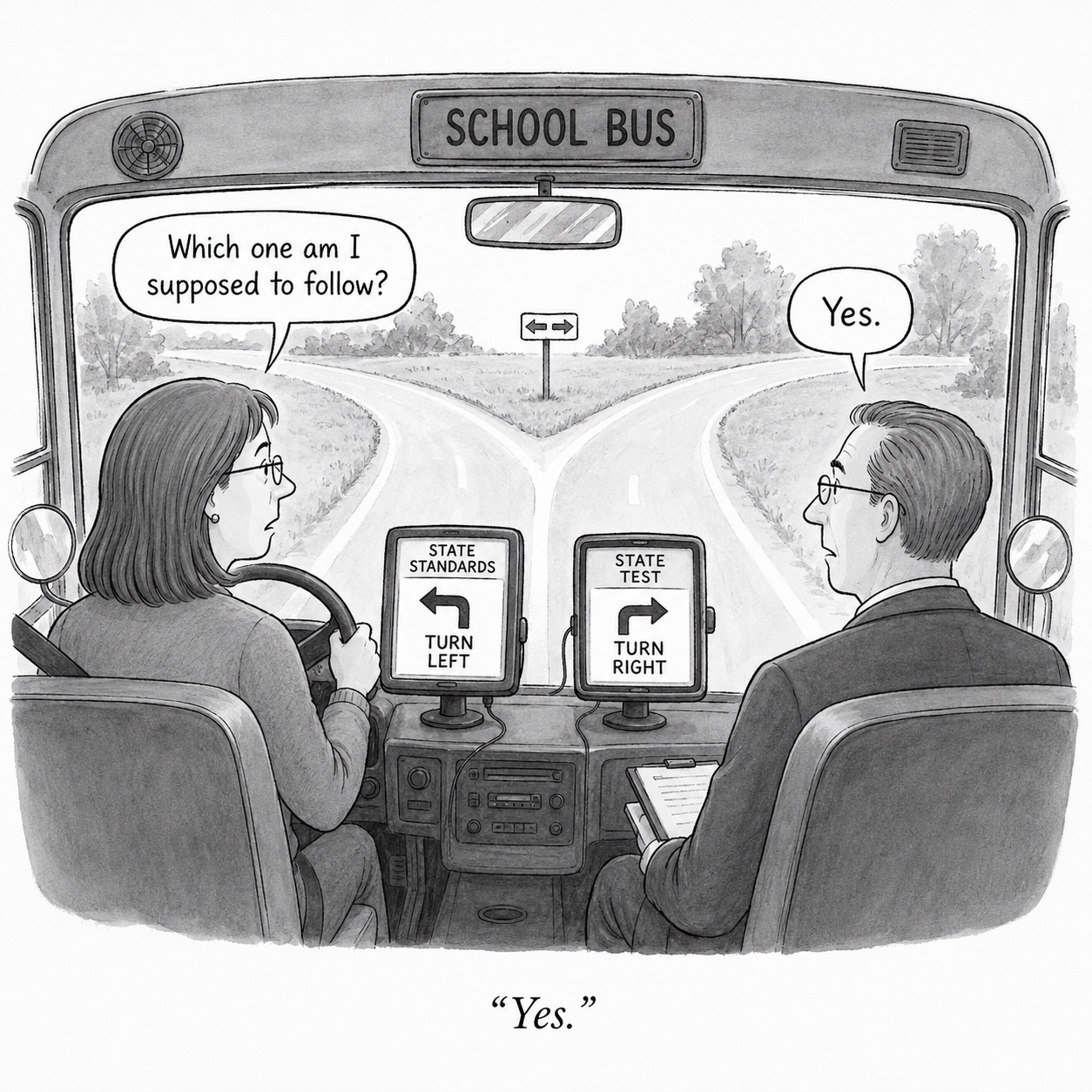
Unfortunately—like all laws and regulations—standards can be misunderstood. As in any regulated field, those bound by a rule tend to read it in whatever way demands the least change from what they already do or value. They can be misunderstood by non-experts or those who attempt to take portions of them out of context. They can be misunderstood by experts who don’t want to concede that they lack authority to shape schools to conform to their whims or will. And they can be misunderstood by the many levels of people who are supposed to do their work in compliance with them.This is no different than any other type of law or regulation. In other fields, we see lawsuits over government officials misapplying or misunderstanding laws or regulations. We even see that in education. Standards are referenced in education adequacy lawsuits, and perhaps there should be lawsuits over misaligned items and the most indefensible interpretations of standards.
So, getting back to item alignment, items must align to standards.
Assessments communicate to districts and teachers how they should interpret the standards and what they should teach. They include operationalized examples of learning standards in action. Therefore, they impact curriculum and instruction. Improperly aligned items send the wrong signals to districts and teachers about what the standards are, actively misinforming the public. They replace the carefully and publicly crafted substance of the legally ratified law or regulation with the convenience or judgment of all-but invisible lower level officials and workers. And convenient misreadings, once made, don't stay put—they get built into curricula, professional development, and institutional habit, and each new cohort inherits them as though they were the standard itself. Therefore, poorly aligned items are quite literally anti-democratic.
Assessments gather information about (select types of) school performance. Most importantly, this information is reported to the public. The public does not see individual report cards, or even aggregate report cards. Schools generally report some sort of graduation rate statistic, and the public can see the performances of sports teams, school bands and drama clubs/classes. They might be able to attend a science fair or the like. But public reporting on large scale assessment results really is the only grade-by-grade reporting on the consensus most important mission of our schools: teaching core academic lessons. They are the only way that the voting public can evaluate the academic performance of their schools. Poorly aligned items misrepresent that performance because they claim to measure something that they do not. They mislabel the results. They actively deceive the public about a matter of public concern. They are, therefore, incredibly anti-democratic.
Carefully aligned assessments (built of carefully aligned items) and the public learning standards to which they are supposed to be aligned are the democratic accountability mechanism of our public schools. They clarify expectations of our elected and senior appointed officials to districts and teachers and report on performance to the public. Interfering with either half of those mechanisms is unethical and undermines the moral legitimacy of our schools, of so much of our local and state taxes and of the (almost-but-not-quite) requirement that parents send their kids to public schools.
Item alignment matters. A lot.