
Two of the most acclaimed geniuses of the twentieth century were physicists—practitioners of a field so dependent upon mathematics that entirely new branches of math have been invented to do the work that physics required.
Their genius was not actually the math.
Stephen Hawking realized early in his life that his physical disabilities would not allow him to lean into the mathematics the way his colleagues did. He could not write out equations and notations in the conventional way. Which was fine, because that was not his genius. What he brought was the ability to visualize the geometry of spacetime and interpret physical reality in ways no one else had managed. One of the greatest physicists of the twentieth century. His genius was interpretive mastery.
Albert Einstein—the reason we use the name "Einstein" to denote genius itself—was not responsible for getting all the mathematics right in his papers. His wife is said by some historians to have helped; a close friend supplied the Riemannian geometry required for general relativity. His genius lay elsewhere. Einstein's path to relativity ran through thought experiments—imagining riding alongside a light beam, imagining an elevator in free fall. He grasped the physics conceptually before he had the mathematics to express it. The interpretation came first. The numbers followed. They were true to each other.
Physics is demanding. It includes math. But the rigor is not just in the math. In much of science, the actual math is literally formulaic. You know which equation to use; you plug in the values; you get the answer. That part is not where the genius lives.
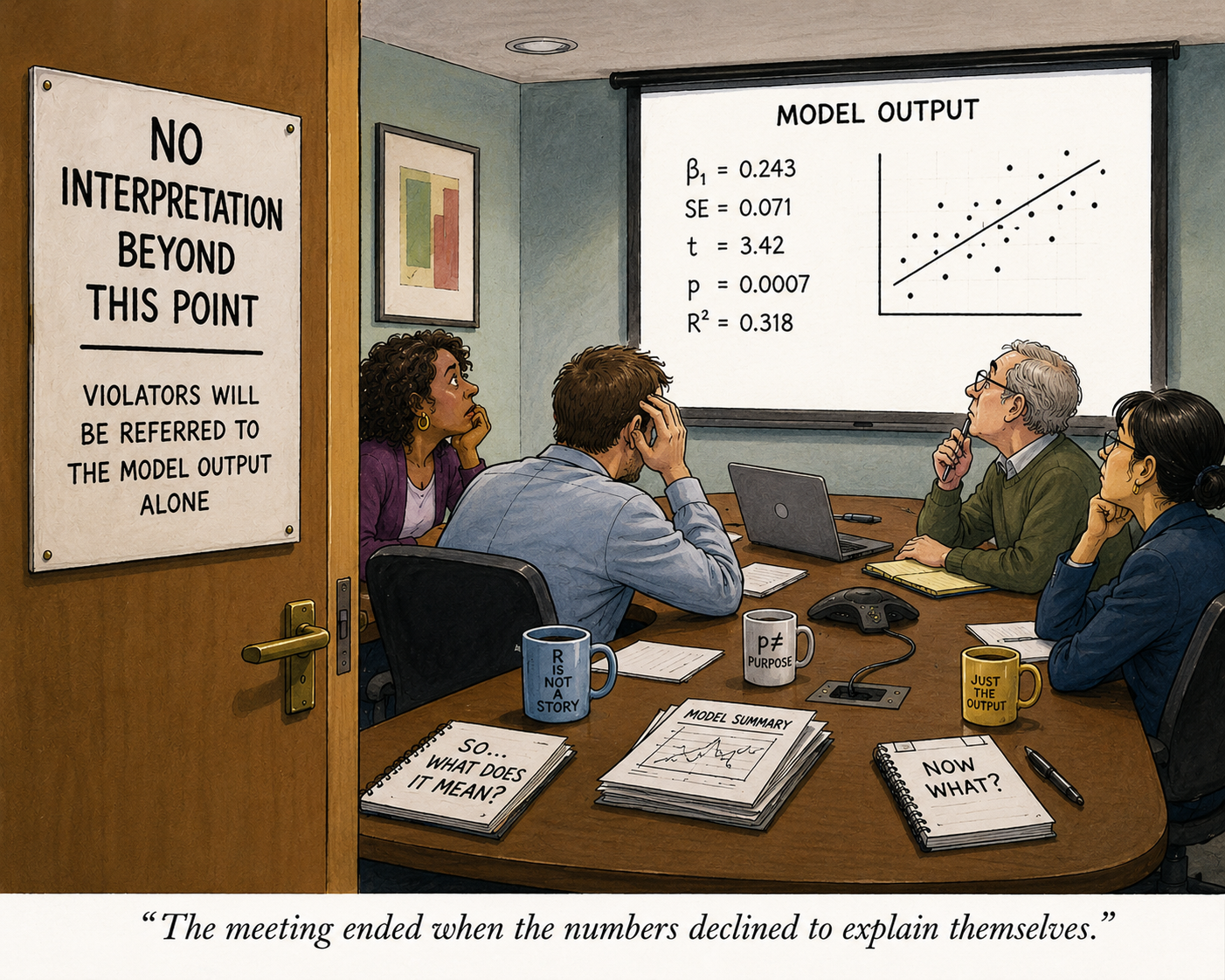
The rigor in natural science is in the inquiry. In figuring out what you even want to test—recognizing a phenomenon, hypothesizing about it, finding a way to quantify it, doing the quantitative work, and then getting back out of the numbers. Back to the real meaning, in terms of the phenomenon. The numbers are often the easiest part.
The hardest part? The bridges. First, from something qualitative and real to a quantified proxy. And then second, from those numbers back into the qualitative phenomenon. Doing those translations while remaining true to the source—true to the phenomenon when quantifying, and true to the numbers when interpreting back into the terms of the real world. Real rigor is in that faithfulness. Andrew Ho teaches that educational measurement must be qualitative, then quantitative, then qualitative again. He is right. And that sequence applies far beyond educational measurement.
Consider a structural engineer's analysis of a bridge design. The load calculations are exact. The strengths of the steel and concrete are what they are. The numbers are non-negotiable—and any interpretation that ignores them will get people killed. And yet those numbers do not design the bridge or determine how to balance its strength and its expected load. Do you add more rebar? Redesign the load distribution? Post a weight limit? Serious engineers can look at the same numbers and reach different defensible conclusions. The numbers constrain every possible answer, though they do not produce one.
Once we recognize that it is not numbers that make for rigor, we should be able to see that rigor exists in word-oriented epistemologies as well. The disciplined acts of careful interpretation—in law, in philosophy, in literary scholarship, in religious textual traditions—are held to the same standard. The rigor lies in fidelity to the text. What does this statute actually say? What does this passage actually mean? What does this argument actually establish? These are not soft questions. They have possible answers and wrong answers—answers the text itself can support or refute. A lawyer who ignores what the statute says is not interpreting freely; she is being unfaithful to her evidence. Scholars in these traditions are held to exacting standards: quote accurately, represent sources faithfully, do not put words in mouths, do not misrepresent arguments. These are not courtesy norms. They are the standards of rigor. We all know what it looks like when they are violated. Everyone who has written a literature review was taught the importance of reporting truthfully on what the literature says, and what it might imply. Those who are not faithful to their sources are hacks, regardless of the discipline or epistemology.
Good and rigorous work is hard. Hack work is easy, regardless of the field, discipline or epistemology.
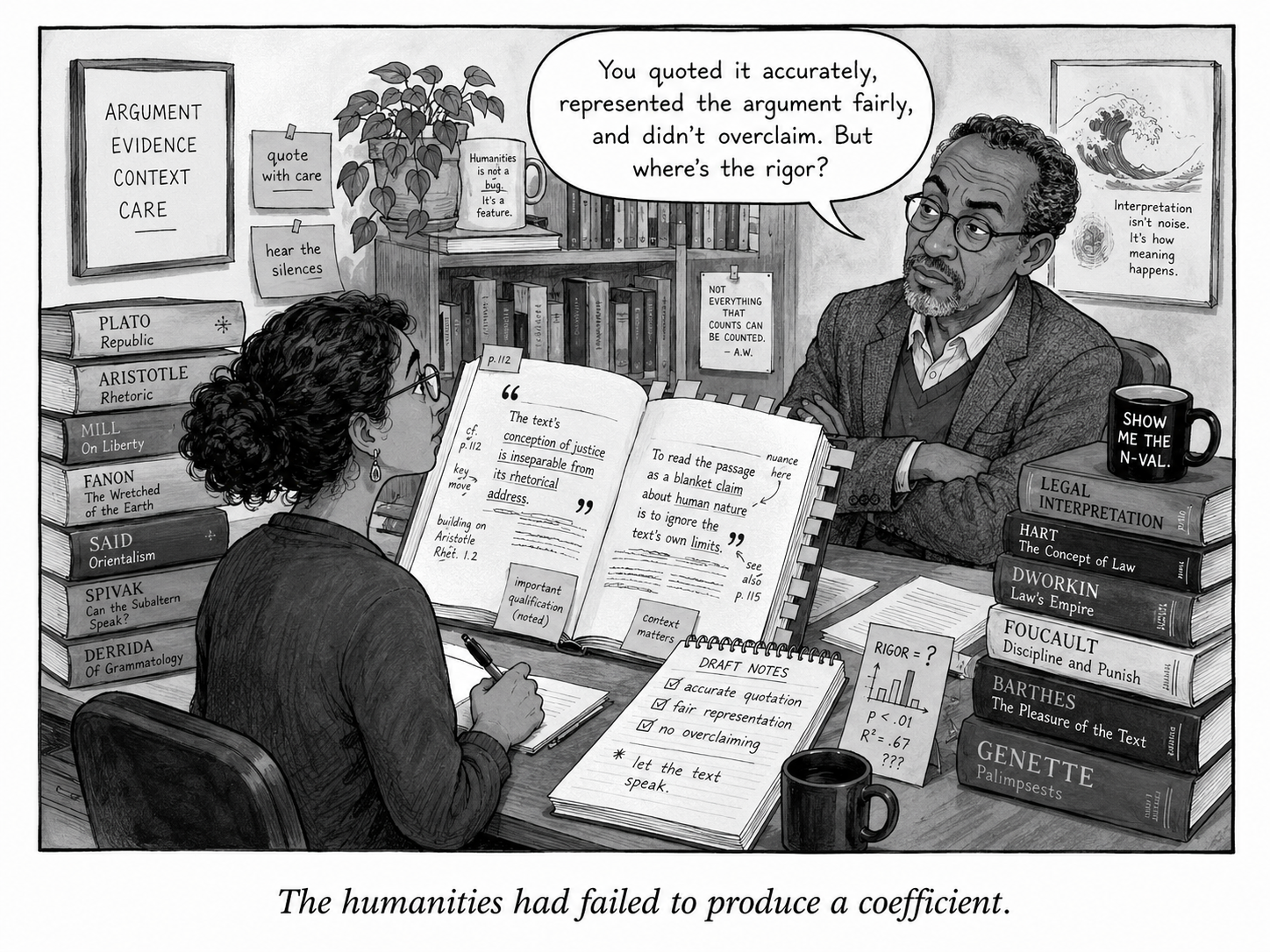
Rigor in word-oriented epistemologies actually has a longer history than rigor in quantitative ones. The degree is called a Doctor of Philosophy. The natural sciences grew out of what was once called natural philosophy—traditions of rigorous argument, careful reasoning, and disciplined interpretation that predate quantification. Quantification was built on them. To fail to see rigor in word-oriented work because it lacks numbers or advanced math is to miss the forest for the trees.
I was a math and science person. STEM high school before STEM was even a thing. All the AP courses. County math team. Summers studying more math and more science. It then took four years of college and more years of serious effort in graduate school to trust that I could do good qualitative work. I have never been able to shake the epistemologies that originally seemed so natural to me, but I continue to work at it. The parallels across epistemologies are real—the demands of clear communication, strict thinking, and faithful engagement with evidence are recognizable everywhere—but seeing them requires work.
(Someone looking for the true soul of mathematics could do far worse than the CCSS standards for mathematical practice. And someone who understands word-oriented epistemologies can read those descriptions of fundamental mathematical thinking and see their own epistemology right there between the lines.)
Neither numbers nor advanced math makes something rigorous. Hack statistical work can be found everywhere. Rigor does not come from numbers. It comes from holding ourselves and our work to the demands of our methodologies, of honoring the demands of our epistemologies. In taking seriously the obstacles and challenges, even when they make the work harder and keep us from simply and easily reaching desired conclusions. And in so many fields, it means honoring the words.